Newest Post
The arguments which favor spelling out the Universe having a begin- ning in this way, also favor spelling out time having a beginning in this way. Time would have a beginning if there was a period of empty time before there was time - which is incoherent. So time could not have a beginning. Time must be without beginning. So if the notion of the Universe having or not having a beginning can be spelled out coherently for universes of different kinds, it will be in terms of a time which cannot have a beginning. Our concept of time is the concept of a background against which things come into being, change, and cease to be. We need it to elucidate the notion of the Universe having a beginning. We would be depriving it of its role in our conceptual scheme which would be the poorer thereby, if we allowed it to be the sort of thing which could itself have a beginning.
Given my fourth thesis that there is no content in supposing that a temporal interval could have any other length than would be measured by a perfect clock, it follows that any time before there was a Universe would have no metric. The beginning of the Universe would be, if there was one on our definition, an actual event. So we can talk of the period of time which ends with that event. But there would be no content to talk about half an hour before the beginning of the Universe as opposed to an hour before that beginning. For 'half an hour before the beginning of the Universe' can only be identified by a possible event - the event of a perfect clock pointing to the hour, such that it would advance in accord with laws of nature by a half-revolution so that it was pointing at the half-hour when the Universe began. But that description will only pick out a definite instant if the clock and any other substances there hap- pened to be would have behaved in accord with laws of nature up to and including the period when substances actually began to exist. But that could not have been - for if the laws had operated, substances would not have come into existence when they did. The beginning of existence of substances (understood in our wide sense) could not have occurred in accord with laws of nature. For laws prescribe which substances or events cause or are necessarily simultaneously correlated with other events. And when there were no substances already existing or events occurring there would be nothing to cause new ones. Put another way - it follows from my four theses that instants which cannot be distin- guished by the actual events which they bound, can only differ if they bound different possible events and that will only be if they are at a different temporal distance from different actual events. So where there is no true metric of temporal distance, there is nothing to make an instant this one rather than that one. Hence any period ending with the begin- ning of the Universe is the same as any other; any time before the beginning of the Universe is amorphous - from which it follows that, if the Universe began, there is nothing to be explained about why it began at this instant rather than that.
The Universe's having a beginning, now interpreted in terms of (2) is compatible with both (1) and (1'). We have seen that there could be a period of empty time even before an infinite series of periods. (1') is also compatible with (2'). It could be instead that the infinite series of periods of the Universe's existence filled the whole of time - there was no empty time left over. But what is not possible is that (1) and (2') both be true. If the Universe has existed only for a finite number of periods of time, then it had a first (initially bounded) period. But time cannot, I have argued, have a first (initially bounded) period. So there must have been time before the universe began. What can the physical cosmologist show us about whether the Uni- verse had a beginning (in my preferred sense)? The scientist observes the present state of the Universe and postulates the simplest laws which will explain its present state. The only way in which he can reach justified conclusions about how things were is by extrapolating backwards from the present state of the Universe in accord with these laws. He may find that we can extrapolate backwards to states of the Universe for an infinite period of time, without reaching impossible states - as once upon a time steady state theory purported to show. Extrapolation from the ways things behave in our narrow region of space-time to how things behaved 101010 billion years ago will be a shaky inference, since it will be derived from a general theory of cosmology claimed to hold over a large period of time but confirmed only by evidence observed in a relatively small region of space over a relatively small period of time. A fortiori, inference to how things were for any n, n years ago can only be tentative in the extreme. But even if the tentative conclusion that the Universe has lasted an infinite number of years were correct, that could be compatible - given my earlier argument - both with the Universe having a beginning and with it not having a beginning. And I cannot see that the scientist's results would favor one of these alternatives against the other. Alternatively the scientist might show that the present data confirm laws of nature such that we cannot extrapolate backwards, to states of the Universe for an infinite period of time, but only for a finite time. Backwards extrapolation might lead us eventually to a singularity - as in current Big Bang theory, 15 billion years ago - such that if there were substances before that singularity, they must have obeyed different laws. But I suggest that in the absence of positive evidence, it is better justified to postulate nothing than something; and if so, the best justified conclu- sion would be that the Universe began a finite time ago. So physical cosmology could never show us that the Universe had no beginning but it could show us (on balance of evidence) that it had a beginning (in the only clear sense of having a beginning which there is). I began this paper by arguing for four modestly verificationist theses about certain concepts crucial in this area, such as 'period' and 'instant.' I then went on to argue that in consequence of these theses the only coherent account which could be given of the Universe having / not having a beginning was in terms of its existence being preceded by / not preceded by a period of empty time. It followed that it is not logically possible for time to have a beginning. It also followed that physical cosmology could never show us that the Universe had no beginning, but it could show us that the Universe did have a beginning
Alat musik
Kacapi ( kecapi) Salah satu alat musik petik tradisional Sulawesi
Selatan khususnya suku Bugis, Bugis Makassar dan Bugis Mandar. Menurut
sejarahnya kecapi ditemukan atau diciptakan oleh seorang pelaut, sehingga
bentuknya menyerupai perahu yang memiliki dua dawai, diambil karena penemuannya
dari tali layar perahu. Biasanya ditampilkan pada acara penjemputan para tamu,
perkawinan, hajatan, bahkan hiburan pada hari ulang tahun.
Salah satu alat musik petik tradisional Sulawesi
Selatan khususnya suku Bugis, Bugis Makassar dan Bugis Mandar. Menurut
sejarahnya kecapi ditemukan atau diciptakan oleh seorang pelaut, sehingga
bentuknya menyerupai perahu yang memiliki dua dawai, diambil karena penemuannya
dari tali layar perahu. Biasanya ditampilkan pada acara penjemputan para tamu,
perkawinan, hajatan, bahkan hiburan pada hari ulang tahun.
Sinrili
 sinrili
Pa' Gendang
seruling Suling bambu/buluh, terdiri dari tiga
jenis, yaitu:
Suling bambu/buluh, terdiri dari tiga
jenis, yaitu:
• Suling panjang (suling lampe), memiliki 5 lubang nada. Suling jenis ini telah
punah.
• Suling calabai (Suling ponco),sering dipadukan dengan piola (biola) kecapi
dan dimainkan bersama penyanyi
• Suling dupa samping (musik bambu), musik bambu masih terplihara di daerah
Kecamatan Lembang. Biasanya digunakan pada acara karnaval (baris-berbaris) atau
acara penjemputan tamu.
• Tari Paduppa Bosara; tarian yang mengambarkan bahwa orang Bugis jika
kedatangan tamu senantiasa menghidangkan bosara, sebagai tanda
kesyukuran dan kehormatan.

• Jenis tarian yang lain adalah tari Pangayo, tari Passassa’, tari Pa’galung,
dan tari Pabbatte (biasanya di gelar padasaat Pesta Panen).
Salah satu alat musik petik tradisional Sulawesi
Selatan khususnya suku Bugis, Bugis Makassar dan Bugis Mandar. Menurut
sejarahnya kecapi ditemukan atau diciptakan oleh seorang pelaut, sehingga
bentuknya menyerupai perahu yang memiliki dua dawai, diambil karena penemuannya
dari tali layar perahu. Biasanya ditampilkan pada acara penjemputan para tamu,
perkawinan, hajatan, bahkan hiburan pada hari ulang tahun. sinriliSuling bambu/buluh, terdiri dari tiga
jenis, yaitu:• Suling panjang (suling lampe), memiliki 5 lubang nada. Suling jenis ini telah punah.
• Suling calabai (Suling ponco),sering dipadukan dengan piola (biola) kecapi dan dimainkan bersama penyanyi
• Suling dupa samping (musik bambu), musik bambu masih terplihara di daerah Kecamatan Lembang. Biasanya digunakan pada acara karnaval (baris-berbaris) atau acara penjemputan tamu.
• Tari Paduppa Bosara; tarian yang mengambarkan bahwa orang Bugis jika kedatangan tamu senantiasa menghidangkan bosara, sebagai tanda kesyukuran dan kehormatan.
• Jenis tarian yang lain adalah tari Pangayo, tari Passassa’, tari Pa’galung, dan tari Pabbatte (biasanya di gelar padasaat Pesta Panen).

 Masakan khas
daerah Makassar, selain Coto adalah Sop Konro. Makanan ini disajikan dalam dua
bentuk, yaitu sop berkuah maupun dibakar dengan bahan-bahan dasar seperti
tulang rusuk sapi atau kerbau, dimasak/dibakar dengan bumbu ketumbar, jintan,
sereh, kaloa, bawang merah, bawang putih, garam, vitsin yang sudah dihaluskan.
Sop Konro pada umumnya disajikan/dimakan bersama nasi putih dan sambal. Rasanya
sangat Khas dengan bumbu yang sangat terasa. Kisaran harganya Rp 10.000 – an.
Saran tempat yang paling enak adalah Konro Jalan Singa yang pernah masuk SCTV.
Masakan khas
daerah Makassar, selain Coto adalah Sop Konro. Makanan ini disajikan dalam dua
bentuk, yaitu sop berkuah maupun dibakar dengan bahan-bahan dasar seperti
tulang rusuk sapi atau kerbau, dimasak/dibakar dengan bumbu ketumbar, jintan,
sereh, kaloa, bawang merah, bawang putih, garam, vitsin yang sudah dihaluskan.
Sop Konro pada umumnya disajikan/dimakan bersama nasi putih dan sambal. Rasanya
sangat Khas dengan bumbu yang sangat terasa. Kisaran harganya Rp 10.000 – an.
Saran tempat yang paling enak adalah Konro Jalan Singa yang pernah masuk SCTV. Barobbo
adalah bubur jagung khas Bugis Makassar, rasanya enak dan mengenyangkan.
Barobbo’ adalah campuran irisan jagung muda, sayur-sayuran, ayam atau udang
yang dimasak dan menjadi bubur yang super lezat. Di sudut kota Makassar ada
beberapa warung yang menyediakan kuliner ini, tetapi di daerah sulawesi selatan
biasanya setiap musim jagung tiba ini adalah menu yang mempersatukan,
seringkali kita mendengar Barobbo’ Party/ pesta barobbo.
Barobbo
adalah bubur jagung khas Bugis Makassar, rasanya enak dan mengenyangkan.
Barobbo’ adalah campuran irisan jagung muda, sayur-sayuran, ayam atau udang
yang dimasak dan menjadi bubur yang super lezat. Di sudut kota Makassar ada
beberapa warung yang menyediakan kuliner ini, tetapi di daerah sulawesi selatan
biasanya setiap musim jagung tiba ini adalah menu yang mempersatukan,
seringkali kita mendengar Barobbo’ Party/ pesta barobbo.

 Pisang Epe
adalah salah satu jajanan khas Makassar, makanan ini terbuat dari pisang yang
dibakar lalu di epe ( digepengkan / dipipihkan ) dan disiram dengan gula merah
cair ber-aroma durian. Pisang Epe ini juga bervariasi, ada yang ditaburi kelapa
sangrai, keju , coklat ataupun kacang panggang. Kalau mau menemukan Pisang Epe
silahkan anda menelusuri jalan sepanjang Pantai Losari, disana banyak sekali
Penjual Pisang Epe. Harganya pun relatif murah, sekitar Rp 5.000-an satu
porsinya.
Pisang Epe
adalah salah satu jajanan khas Makassar, makanan ini terbuat dari pisang yang
dibakar lalu di epe ( digepengkan / dipipihkan ) dan disiram dengan gula merah
cair ber-aroma durian. Pisang Epe ini juga bervariasi, ada yang ditaburi kelapa
sangrai, keju , coklat ataupun kacang panggang. Kalau mau menemukan Pisang Epe
silahkan anda menelusuri jalan sepanjang Pantai Losari, disana banyak sekali
Penjual Pisang Epe. Harganya pun relatif murah, sekitar Rp 5.000-an satu
porsinya.7. Es Pallu Butung
 Es Pallu
Butung adalah makanan penutup sangat populer dari Makassar, Sulawesi Selatan.
Es ini biasa tersaji di warung-warung atau rumah makan di Makassar, serta di
pinggiran jalan di Makassar. Apalagi kalau Bulan Ramadhan, mungkin ini
makanan terlaris di Kota daeng. Paduan Pisang Raja dan Kuah putih yang mantap,
anda harus merasakan sensasi kuliner yang satu ini. Harga per porsi
biasanya Rp 5.000-an.
Es Pallu
Butung adalah makanan penutup sangat populer dari Makassar, Sulawesi Selatan.
Es ini biasa tersaji di warung-warung atau rumah makan di Makassar, serta di
pinggiran jalan di Makassar. Apalagi kalau Bulan Ramadhan, mungkin ini
makanan terlaris di Kota daeng. Paduan Pisang Raja dan Kuah putih yang mantap,
anda harus merasakan sensasi kuliner yang satu ini. Harga per porsi
biasanya Rp 5.000-an.

Barongko adalah makanan penutup khas daerah Bugis-Makassar yang dibuat dari buah Pisang Kepok matang yang dikukus dengan daun pisang. Dahulu paada masa pemerintahan kerajaan di Sulawesi Selatan, Barongko merupakan makanan penutup yang mewah, dan hanya disajikan untuk Raja-raja, dan disajikan pada moment-moment tertentu, seperti acara perkawinan, ulang tahun, dan lain. lain. Untuk menambah cita rasa dan selera, bahan dasar Barongko biasanya ditambah dengan irisan buah Nangka atau Kelapa muda.
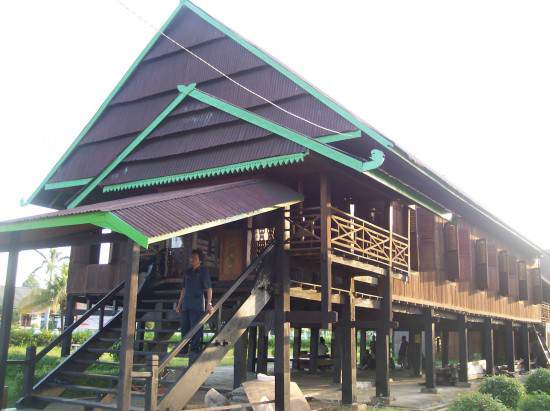
 Umumnya rumah orang Bugis berbentuk rumah
panggung dari kayu berbentuk segi empat panjang dengan tiang-tiang yang tinggi
memikul lantai dan atap. Konstruksi rumah dibuat secara lepas-pasang (knock
down) sehingga bisa dipindahkan dari satu tempat ke tempat lain.
Umumnya rumah orang Bugis berbentuk rumah
panggung dari kayu berbentuk segi empat panjang dengan tiang-tiang yang tinggi
memikul lantai dan atap. Konstruksi rumah dibuat secara lepas-pasang (knock
down) sehingga bisa dipindahkan dari satu tempat ke tempat lain.